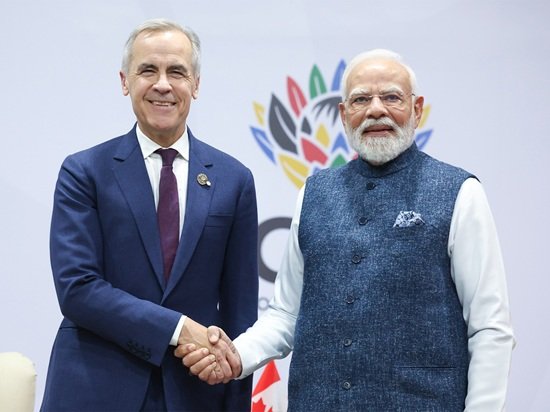
Canada, November 24, 2025-BNN Web Staff: Canadian Prime Minister Mark Carney has accepted Prime Minister Narendra Modi’s invitation to visit India in early 2026, the Canadian Prime Minister’s Office confirmed on Sunday.
The two leaders have been working to rebuild momentum in bilateral ties since the reinstatement of high commissioners in August 2025. Both prime ministers agreed to expand diplomatic staffing to address rising consular needs and to promote stronger people-to-people engagement. They also committed to encouraging the exchange of expertise in various sectors as part of an ongoing collaborative framework.
Carney expressed appreciation for the recent progress in cooperation between Indian and Canadian law enforcement agencies. He also announced that New Delhi and Ottawa will soon begin negotiations on a Comprehensive Economic Partnership Agreement (CEPA), following his meeting with PM Modi on the sidelines of the G20 Leaders’ Summit. The proposed agreement aims to increase bilateral trade to USD 50 billion by 2030.
After their discussion, PM Modi said the two sides recognized the renewed “energy” in their relationship and vowed to deepen collaboration across key sectors. In a post on X, he wrote, “Had a very productive meeting with Prime Minister Mark Carney of Canada. We acknowledged the significant momentum in our bilateral ties since our meeting at the G7 Summit.” He added that both nations would step up cooperation in trade, investment, technology, innovation, energy and education.
PM Modi remarked that Canadian pension funds are showing growing interest in India’s economic landscape. He also noted plans to enhance partnerships in defence and space technologies during upcoming engagements between the two sides.
According to the Ministry of External Affairs, both countries reaffirmed their long-standing civil nuclear partnership and discussed expanding uranium supply arrangements.
During an interaction with journalists, Carney described India as a trustworthy economic partner and emphasized the potential of a CEPA with a major and rapidly expanding global economy. He said such a pact would boost bilateral trade, provide businesses with clearer regulations, and offer a stronger dispute-resolution mechanism.
Carney also highlighted India’s expanding role in renewable energy industries like solar and wind. Canada, he noted, is seeking to diversify supply chains away from China, with India and South Korea emerging as key alternatives.
This meeting marked the first formal bilateral interaction between the two leaders since their talks at the G7 Summit in Kananaskis in June. That meeting played a crucial role in stabilizing ties, which had deteriorated after former PM Justin Trudeau alleged in 2023 that Indian agents were linked to the killing of Hardeep Singh Nijjar—allegations India rejected outright.
Since Carney assumed office in March, both sides have taken steps to re-engage. Earlier this weekend, India, Canada and Australia jointly launched the Australia-Canada-India Technology and Innovation (ACITI) Partnership, aimed at strengthening cooperation in emerging technologies, clean energy, supply chain diversification and artificial intelligence.
Carney, in a separate post, said Canada and India will work more closely in the fields of clean energy, critical minerals and AI to generate new research and economic opportunities.