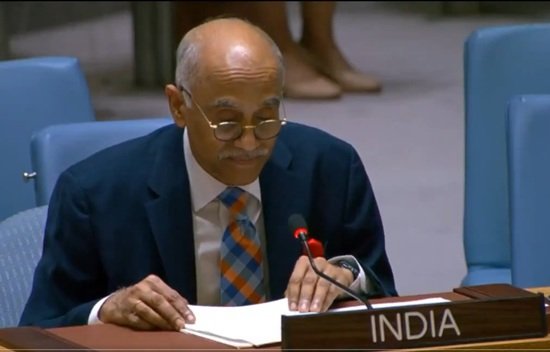
India’s envoy cites Pakistan’s 1971 atrocities as proof that a nation violating women’s dignity cannot champion peace or human rights.
New York [US], October 7, 2025: India has delivered a strong rebuttal to Pakistan at the United Nations, condemning its history of atrocities against women and calling out its hypocrisy during a UN Security Council debate on Women, Peace, and Security.
India’s Permanent Representative to the UN, Ambassador Parvathaneni Harish, said Pakistan had no moral authority to speak on women’s rights after its army committed genocidal sexual violence against nearly 400,000 women during Operation Searchlight in 1971.
“Every year, we are forced to hear Pakistan’s delusional tirade against India, particularly regarding Jammu and Kashmir. A nation that bombed its own people and sanctioned a campaign of genocidal mass rape against 400,000 of its women citizens has no moral standing to lecture others,” Harish said at the debate. “The world sees through Pakistan’s propaganda and misdirection.”
His remarks came in response to comments made by Counsellor Saima Saleem of Pakistan’s Permanent Mission to the UN, who raised Kashmir-related issues during the session.
The UNSC discussion marked the 25th anniversary of UN Resolution 1325, which recognises the disproportionate impact of armed conflict on women and girls and emphasises their role in peacebuilding.
Harish underlined India’s long-standing commitment to women’s empowerment and its “unblemished record” on the Women, Peace, and Security agenda, contrasting it with Pakistan’s record of violence and repression.
Earlier, External Affairs Minister S. Jaishankar had also criticised Pakistan—without naming it—at the UN General Assembly, describing it as “the epicentre of global terrorism” and warning that nations supporting terrorism would ultimately face its consequences.
India’s intervention at the UN not only countered Pakistan’s narrative but also drew global attention to the historic suffering of women during the 1971 Bangladesh Liberation War, framing it as one of the worst instances of gender-based violence in modern history.