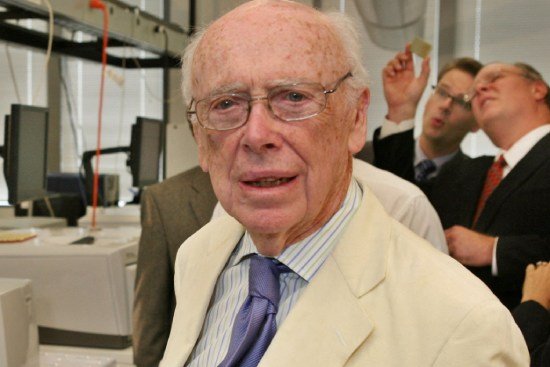
James D. Watson, the Nobel Prize-winning scientist who co-discovered the double-helix structure of DNA, a breakthrough that revolutionized medicine, crime investigation, and our understanding of life itself, has died at the age of 97.
Alongside Francis Crick and with crucial data from Rosalind Franklin, Watson deciphered the “twisted-ladder” structure of DNA in 1953. This discovery revealed how genetic information is stored and copied, laying the foundation for modern molecular biology. The three were jointly awarded the Nobel Prize in Physiology or Medicine in 1962. The iconic double helix has since become a universal symbol of science.
A Legacy Marred by Controversy
Despite his monumental scientific achievement, Watson’s later years were overshadowed by professional condemnation due to his offensive and repeatedly stated views on race and intelligence.
In 2007, after making widely criticized comments about the intelligence of Black people, he was suspended from his position as chancellor of Cold Spring Harbor Laboratory, a world-renowned research institution he had led for decades. The lab stated his views were “reprehensible” and “unsupported by science.”
His remarks drew sharp criticism from peers, including Dr. Francis Collins, former director of the National Institutes of Health, who stated that Watson’s perspectives “were not aligned with his brilliant scientific knowledge” and that his racial comments were “wrong and damaging.”
A Complex and Enduring Legacy
While Watson did not make another experimental discovery on the scale of the double helix, he remained a powerful figure in science. He authored influential books, provided guidance for the Human Genome Project, and mentored numerous young scientists.
In his autobiography, The Double Helix, he offered advice for success in science, emphasizing hard work, intelligence, and facing challenges head-on.
James Watson leaves behind a complex legacy: that of a visionary who unlocked one of nature’s deepest secrets and a controversial figure whose personal beliefs stood in stark contrast to the collaborative and universal spirit of scientific inquiry.