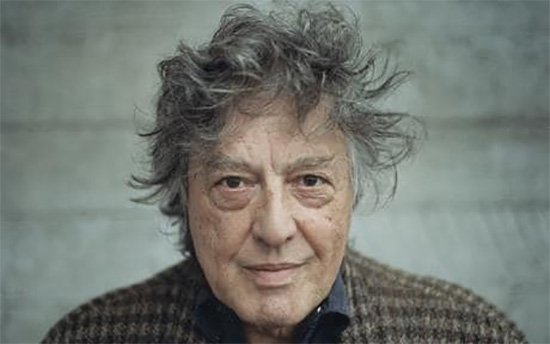
Sir Tom Stoppard, Master of Wit and Philosophical Drama, Dies at 88
Dorset, England – November 29, 2025 (BNN Web Staff) – Sir Tom Stoppard, the brilliant Czech-born British playwright whose works wove intellectual rigor with irreverent humor and profound humanity, has died peacefully at his home at the age of 88. The news was shared in a heartfelt statement from his agency, United Agents, marking the end of a six-decade career that redefined modern theater and earned him Oscars, Tonys, and a knighthood.
“We are deeply saddened to announce that our beloved client and friend, Tom Stoppard, has died peacefully at home in Dorset, surrounded by his family,” the statement read. “He will be remembered for his works, for their brilliance and humanity, and for his wit, his irreverence, his generosity of spirit and his profound love of the English language. It was an honour to work with Tom and to know him.”
Tributes poured in swiftly, with Rolling Stones frontman Sir Mick Jagger calling him his “favourite playwright” on social media. Index on Censorship, where Stoppard was a longtime patron, hailed him as a “visionary dramatist and fierce champion of free expression.”
A Career of Dazzling Innovation
Stoppard’s oeuvre – often described as “Stoppardian” for its playful erudition and improbable juxtapositions – spanned plays, screenplays, and adaptations that challenged norms and celebrated the power of ideas. His breakthrough, Rosencrantz and Guildenstern Are Dead (1966), a tragicomic riff on Shakespeare’s Hamlet from the perspective of its hapless courtiers, premiered at the Edinburgh Fringe and catapulted him to stardom, earning four Tony Awards in 1968.
Other masterpieces included:
- The Real Thing (1982): A witty exploration of love and infidelity.
- Travesties (1974): A farcical mash-up of history, art, and espionage.
- Arcadia (1993): Blending chaos theory, landscape gardening, and romance across centuries – often cited as his finest work.
- The Coast of Utopia (2002): A sprawling trilogy on 19th-century Russian thinkers.
- Leopoldstadt (2019): His semi-autobiographical reflection on Jewish life in early-20th-century Vienna, which won the Olivier Award for Best New Play and four Tonys in 2020, and featured his son Ed Stoppard.
Beyond the stage, Stoppard’s screenplay for Shakespeare in Love (1998) – co-written with Marc Norman – charmed audiences with its meta-romance, netting him an Academy Award, Golden Globe, and BAFTA. He adapted Leo Tolstoy’s Anna Karenina (2012) for the screen, starring Keira Knightley and Jude Law, and penned the BBC miniseries Parade’s End (2012) with Benedict Cumberbatch and Rebecca Hall.
Knighted by Queen Elizabeth II in 1997 for services to literature, Stoppard also received the David Cohen Prize in 2017, joining luminaries like Harold Pinter and Seamus Heaney. PEN America honored him with the Mike Nichols Writing for Performance Award in 2020 for Leopoldstadt.
From Refugee Roots to Theatrical Triumph
Born Tomáš Straußler in Zlín, Czechoslovakia, in 1937 to non-practicing Jewish parents, Stoppard’s early life was scarred by peril. His family fled Nazi occupation in 1939, relocating to Singapore, where his father died during the Japanese invasion. His mother remarried British Army major Kenneth Stoppard, who adopted the boys and brought them to England in 1946 – the source of his adopted surname.
Journalism beckoned first: By 1954, he was a Bristol reporter and theater critic, penning radio plays like Albert’s Bridge and The Real Inspector Hound. His advocacy for Soviet dissidents began with Every Good Boy Deserves Favour (1977), inspired by his friendship with imprisoned Czech activist Viktor Fainberg.
Later works like Heroes (2009), Rock ‘n’ Roll (2006), and The Hard Problem (2015) continued his fusion of philosophy, politics, and pop culture.
Stoppard’s death leaves a void in British arts, but his legacy – a testament to resilience, intellect, and irreverence – endures in every line that sparks laughter and thought. As he once quipped, “It’s not the voting that’s democracy; it’s the counting.” The world will count his contributions for generations.