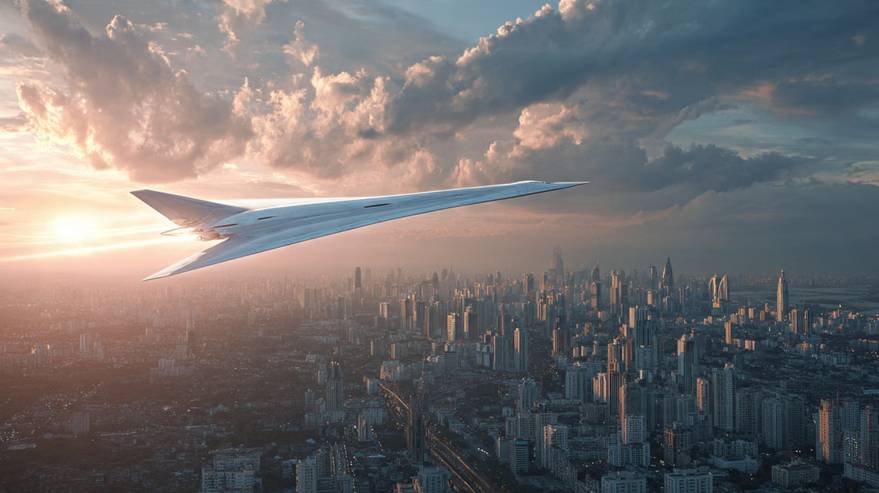
The Future of Flight: If achieving Mach 10 speed ever becomes possible, it could completely transform the face of global air travel. A journey that takes 15 hours today could be completed in less than an hour in the future.
For example, the current 12,000 km flight from Delhi to New York could be completed in just one hour. This means if you start watching a movie during takeoff, you would land in America before the movie ends.
The Current Frontier and The Challenge
While some military aircraft can fly at speeds of Mach 2 or Mach 3, the goal of reaching Mach 10 is a significant leap forward. Mach 1 is approximately 760 miles per hour. An aircraft flying at Mach 10 would have to endure extreme heat and turbulence, which currently presents the biggest engineering challenge.
Key Findings from a New Study
The Stevens Institute of Technology in New Jersey has presented a study on hypersonic aircraft, detailing the essential design and airflow requirements for such vehicles.
According to the study, airflow behavior changes completely at hypersonic speeds. At lower speeds, air density remains relatively constant. However, at high velocities, air compresses, heats up, and its density changes. This, in turn, alters key aerodynamic factors like lift, drag, and thrust.
What Does Mach 10 Mean?
- Most commercial flights cruise at speeds between Mach 0.6 – 0.9, with a maximum speed of 735 to 1,102 km/h.
- The speed of sound in air is measured at about 1,235 km/h.
- An aircraft flying at Mach 10 would travel at over 12,000 km/h—nearly ten times the speed of sound.
Making Space Travel More Affordable
Experts believe that if hypersonic planes become a practical reality, it will change not only travel on Earth but also how we access space. This technology could make it possible to use hypersonic aircraft instead of rockets for space access, realizing the dream of traveling from Earth to space in a fraction of the time.
This kind of progress could make transporting cargo and people to Low Earth Orbit (LEO) significantly easier and more cost-effective. According to scientists, this advancement has the potential to revolutionize travel—both from Earth to space and from one country to another.