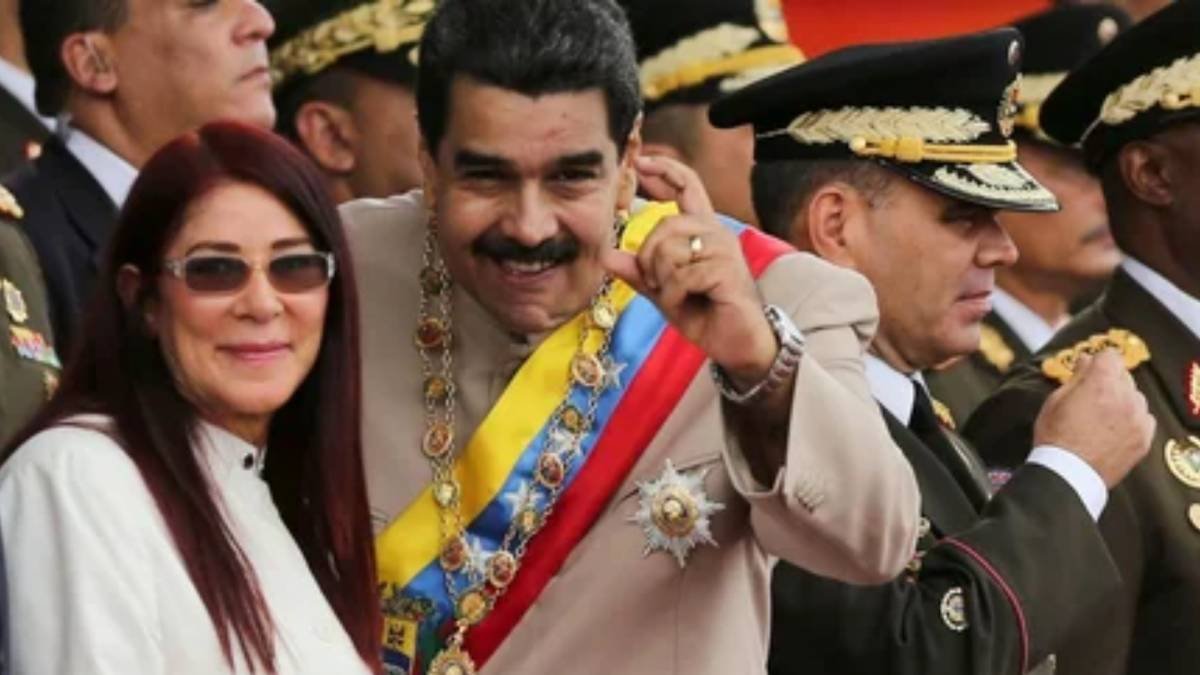
US Captures Venezuelan President Nicolás Maduro and Wife in Dramatic Military Operation; Trial Set for New York on Narco-Terrorism Charges
US, 3 Jan 2026 (BNN Web Staff)-
In a stunning escalation of tensions, U.S. forces conducted a large-scale military strike on Venezuela early on January 3, 2026, resulting in the capture of President Nicolás Maduro and his wife, Cilia Flores. President Donald Trump announced the operation on Truth Social, stating the couple had been “captured and flown out of the Country” and were en route to New York to face long-standing federal charges.
Explosions rocked Caracas and other sites, targeting military facilities including Fuerte Tiuna, Venezuela’s largest complex. Low-flying aircraft and blasts were reported around 2 a.m. local time, prompting panic and power outages in parts of the capital.
Charges and Legal Proceedings
U.S. Attorney General Pam Bondi confirmed a superseding indictment in the Southern District of New York, charging Maduro and Flores with:
- Narco-terrorism conspiracy
- Cocaine importation conspiracy
- Possession of machine guns and destructive devices
Related conspiracies
Bondi praised Trump for his “courage to demand accountability” and thanked U.S. troops for the “brilliant and successful mission” to apprehend the “alleged international narco-traffickers.” The charges stem from a 2020 indictment accusing Maduro of leading the “Cartel de los Soles,” allegedly turning Venezuela into a conduit for massive cocaine shipments to the U.S., in partnership with Colombian rebels.
A $50 million bounty had been placed on Maduro, reflecting the seriousness of the allegations.
U.S. Officials’ Statements
Secretary of State Marco Rubio reposted a prior statement: “Maduro is NOT the President of Venezuela and his regime is NOT the legitimate government. Maduro is the head of the Cartel de los Soles, a narco-terrorist organization which has taken possession of a country.”
Trump, in subsequent remarks, indicated the U.S. would “run” Venezuela temporarily to ensure a “safe transition,” with involvement in its oil sector to rebuild infrastructure.
The operation reportedly involved elite units like Delta Force and was coordinated with law enforcement.
Venezuelan Response and Power Vacuum
Vice President Delcy Rodríguez demanded “proof of life” for Maduro and his wife, condemning the strikes as aggression that killed officials. Speculation arose about Rodríguez assuming interim leadership, though unconfirmed. Some reports suggest a possible “negotiated exit” for Maduro.
The government declared a state of emergency and mobilized defenses, accusing the U.S. of seeking Venezuela’s vast oil reserves.
Background and Escalation
Tensions built over months:
U.S. strikes on over 35 suspected drug-trafficking vessels in the Caribbean since September 2025, killing at least 115.
Deployment of aircraft carriers and a blockade on Venezuelan oil tankers.
Trump’s administration viewed Maduro’s rule as illegitimate following disputed 2024 elections.
Maduro, a former bus driver who rose under Hugo Chávez, has denied drug links, framing U.S. actions as imperialism.
International Reactions
Reactions were sharply divided:
Condemnations: Russia, Cuba, Iran, Brazil, Mexico, Colombia, and France decried violations of sovereignty and international law.
Mixed/Neutral: Some noted Maduro’s lack of legitimacy but urged diplomacy.
Domestic U.S. debate questioned the operation’s legality and congressional oversight.
The event marks the most direct U.S. intervention in Latin America since the 1989 Panama invasion, raising fears of regional instability and a potential power vacuum in Venezuela. The situation remains highly fluid.