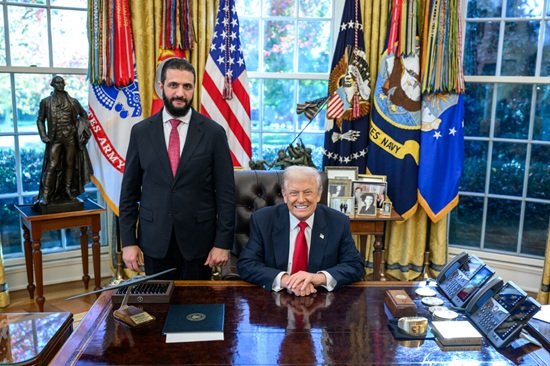
Washington D.C. [US]: In a historic diplomatic development, U.S. President Donald Trump met Syrian President Ahmad al-Sharaa at the White House on Monday (local time), marking the first visit by a Syrian head of state to Washington since Syria’s independence in 1946.
The meeting, focused on restoring peace and stability in the Middle East, came alongside a major U.S. policy shift — a temporary suspension of the Caesar Act sanctions on Syria for 180 days.
The U.S. Treasury Department said the partial waiver aims to “support Syria’s economic rebuilding and reintegration into regional trade frameworks.”
Taking to Truth Social, Trump hailed the discussion as “an honor,” emphasizing that a “stable and successful Syria is vital to all countries in the region.”
He also described President al-Sharaa as a “strong leader” capable of guiding Syria toward peace and recovery.
Al-Sharaa, who emerged as Syria’s leader after the fall of Bashar al-Assad’s regime, has pledged to rebuild the war-torn nation and reestablish diplomatic ties with the West.
The two leaders reportedly discussed cooperation against ISIS, Syria’s reconstruction, and the gradual lifting of international restrictions.
In a coordinated statement, the U.S. Departments of State, Treasury, and Commerce confirmed that while most civilian trade and technology transfers to Syria are now permitted, transactions involving Russia and Iran remain prohibited. Sanctions on individuals linked to human rights abuses, narcotics trafficking, and the former Assad regime also remain in force.
U.S. Secretary of State Marco Rubio noted in an official statement dated November 10 that the decision reflects “President Trump’s commitment to offering the Syrian people a chance at peace and prosperity.”
He added that the U.S. expects “concrete reforms and a sustained effort by Syria to promote stability, human rights, and regional cooperation.”
The suspension of sanctions and the White House meeting signal a significant recalibration of U.S. policy toward Syria — one aimed at ending its long diplomatic isolation and reshaping alliances in the Middle East.