Nuclear Bomb
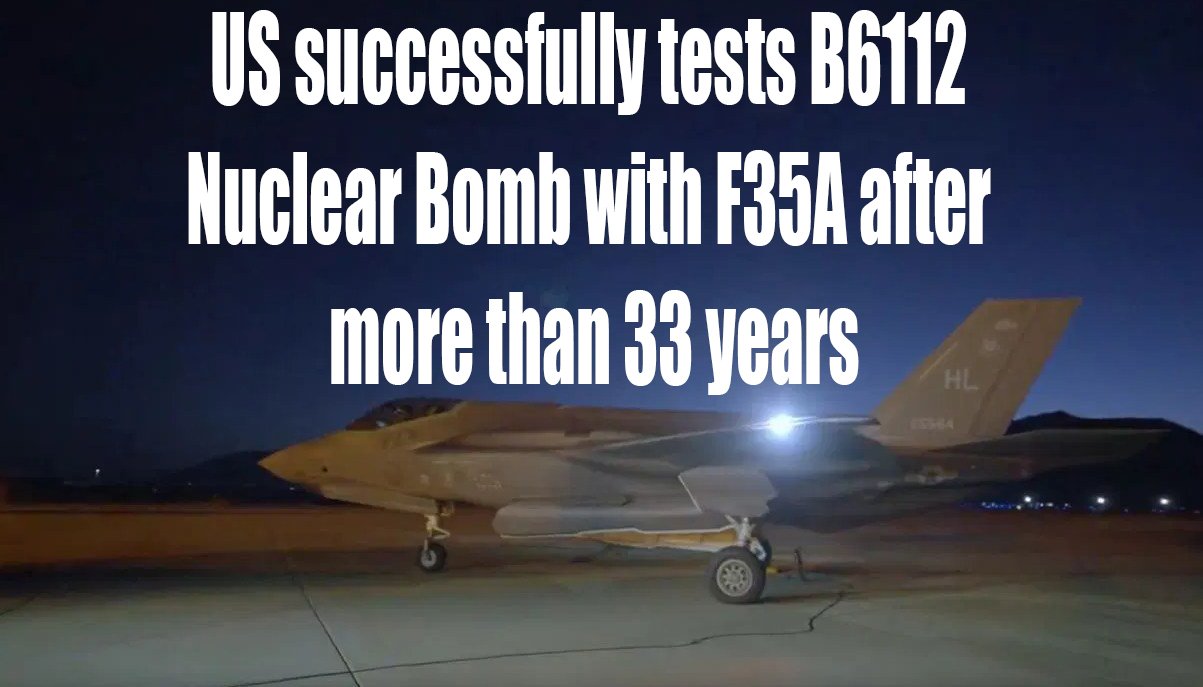
In a significant move, the United States has successfully tested the B61-12 tactical thermonuclear bomb, marking its first such test in over three decades. Notably, this test was conducted using an inert version of the bomb without a live warhead, but it served as a powerful demonstration of American technical prowess.
Sandia National Laboratories, under the US Department of Energy, confirmed that the test was conducted between August 19 and 21 at the Nevada Test Site, utilizing a state-of-the-art F-35A stealth fighter jet.
Bomb Deployed from F-35A
According to reports, during the test, the F-35A carried and released the inert version of the B61-12 within safe parameters, striking the intended target with precision. The test was conducted in collaboration with the NNSA (National Nuclear Security Administration).
A key highlight was the first-time use of thermal preconditioning technology. This involved subjecting the bomb’s joint test assembly to extreme temperature variations to assess its performance and resilience under the harsh conditions of an actual conflict. This was the first-ever experiment of its kind conducted with the F-35.
What is the B61-12 Bomb?
The B61-12 is the newest and most advanced variant of America’s longstanding and reliable B61 nuclear bomb family, which has been in service since 1968. It is an air-dropped nuclear gravity bomb.
- Compatible Aircraft: It can be launched from aircraft including the B-2A, F-15E, F-16, PA-200, F-35, and the upcoming B-21.
- Specifications: It is approximately 12 feet long and weighs about 825 pounds (374 kg).
- Capabilities: It can engage targets in two modes—gravity mode (free-fall) and guided mode (precision strike). The B61-12 is designed to be safer, more accurate, and offer greater tactical flexibility compared to older nuclear technologies.
Service Life Extended by 20 Years
Sandia announced that the B61-12 Service Life Extension Program was completed by the end of 2024, extending the bombs’ lifespan by 20 years. This is strategically crucial as it ensures the US maintains a strategic advantage for coming years without needing a major overhaul of its nuclear capabilities.
In March 2024, the F-35A was officially certified to carry and deploy the B61-12. This certification makes the F-35A a “dual-capable” aircraft, meaning it can now deliver both conventional and nuclear weapons.